ISO 27001 pentest
If you are working towards ISO 27001 certification, the auditor will want proof that your technical security is actually tested. A pentest is that proof. We run the test, map every finding to the right Annex A control and keep the evidence dated, so the answer is ready before the auditor asks the question.
Request pentest- Current on ISO 27001:2022 with its 93 controls
- Every finding mapped to Annex A
- Yearly testing is the norm before every audit
- Fixed price up front, no cure no pay
What is an ISO 27001 pentest
An ISO 27001 pentest is a penetration test carried out for an ISO 27001 certification or audit. Ethical hackers attack your applications and infrastructure under controlled conditions, hunt for the weaknesses an attacker would use and record the results as evidence for your auditor. The test itself is no different from any other pentest. The difference is in the reporting, because every finding is mapped to the Annex A controls it belongs to.

What is ISO 27001
ISO 27001 is the international standard for information security management. A certified organisation has had an independent auditor confirm that it knows its risks, has chosen controls for them and can show those controls work. Which controls apply is your own decision, based on a risk assessment, and you record that choice in the Statement of Applicability.
The current version is ISO 27001:2022, with 93 controls in Annex A. A certificate is valid for three years. During that period the auditor returns every year for a surveillance audit, and after three years you recertify. At every one of those visits the same question can land on the table. How do you know your technical controls work?
Does ISO 27001 require a pentest
No. The word pentest appears nowhere in the standard, and a vendor who claims it is mandatory is overselling. What the standard does expect is that you find and fix technical vulnerabilities (control A.8.8), that you test software before it goes live (A.8.29) and that your security is reviewed independently at planned intervals (A.5.35).
For each of those requirements a pentest is the most direct evidence there is. A vulnerability scan shows that a tool ran. A pentest shows what an attacker could actually have done, which is evidence an auditor can weigh.
Which Annex A controls does a pentest touch
Mapping a finding to a control is traceability, not certification. But a good penetration test does produce direct evidence for the controls auditors ask about most. These are the six our findings land on most often.
A.8.8 Technical vulnerabilities
The pentest finds them the way an attacker would, and the fixed findings prove you act on them.
A.8.29 Testing in development and acceptance
The security test of what you built, documented before it goes live.
A.8.25 Secure development life cycle
Findings in your own code show where the development pipeline needs attention.
A.5.35 Independent review
An external party periodically reviewing your technical security. That is the pentest itself.
A.5.15 Access control
Every pentest tests whether roles and permissions hold what your policy promises.
A.8.24 Cryptography
Weak encryption and expired configurations surface in every test.
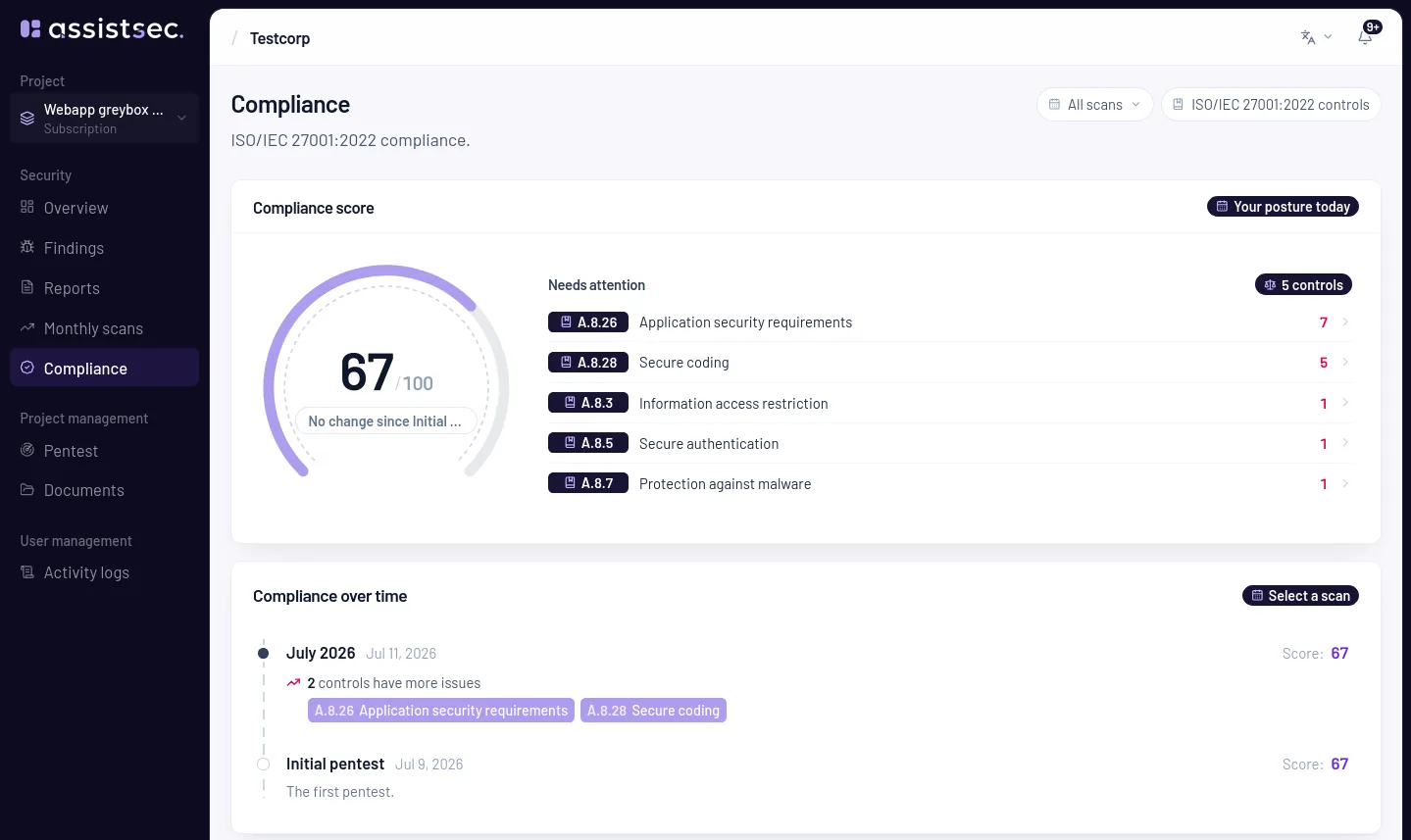
In our portal every finding hangs on the controls it touches, mapped by the pentester who found it. Your auditor reads the evidence per control, with nothing retyped from a PDF.
How an ISO 27001 pentest runs at AssistSec
Intake call
After your request via assistsec.ai, we contact you within 24 hours to schedule an intake call. In that call we discuss your specific question, if needed with one of our pentesters present, set the scope of the pentest and tell you more about how we work.
Test
AI agents and senior pentesters attack the scope under controlled conditions. You watch live in our portal.
Report
Every finding validated by a person, with risk and concrete remediation advice, mapped to Annex A.
Retest
You fix, we verify. Found, fixed and verified, each with a date.
Audit file
You export the evidence per control straight into your file. Ready before the auditor asks.
Every finding mapped to Annex A
Our pentests run in ARGUS, our own portal. There the pentesters map each finding to the Annex A controls it touches, at the moment it is published. The mapping is made by the people who found the issue themselves, not reconstructed afterwards by someone reading through a PDF.
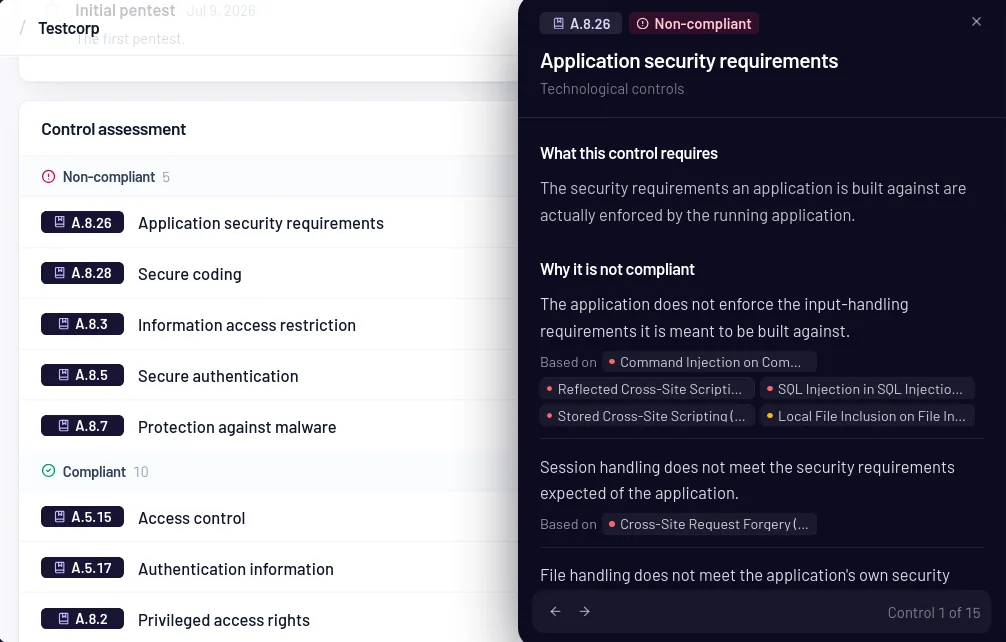
Evidence with dates on it
An auditor wants to know when you tested, what you found and whether it was fixed. In ARGUS every finding shows when it was found, fixed and verified. The retest is part of the engagement, and the evidence can be exported per control. It goes into your audit file as it is, with nothing retyped.
No cure, no pay. We guarantee a validated finding, or you do not pay. This applies to every pentest we run, and you keep the full report either way.
Frequently asked questions
Is a pentest mandatory for ISO 27001 certification?
No. The standard asks for evidence that you manage vulnerabilities and test your controls, but it does not prescribe a method. For controls A.8.8 and A.8.29 a pentest is the most direct evidence, because a scan alone says less. A scan shows that a tool ran, a pentest shows what an attacker could have done.
What is the difference between an ISO 27001 pentest and a regular pentest?
The testing work is the same, the difference is in the reporting. In an ISO 27001 pentest every finding is mapped to the Annex A controls it touches and the evidence is kept dated, so it fits your audit file directly. A standalone security test without that mapping gives the same insight but more sorting work on the way to the audit.
Which pentest do we need for ISO 27001?
The one that covers the systems in your scope. For most organisations that is the web application customers sign in to and the APIs behind it; if your people work in a Windows domain, the internal network belongs in it too. We go through your scope statement with you and say which tests it asks for.
Is a vulnerability scan enough for ISO 27001?
Usually not on its own. A scan shows that a tool ran and lists what it recognised. An auditor looking at A.8.8 wants to see that findings were understood, judged on risk and fixed, which means someone has to confirm a finding is real and reachable. That is what a pentest adds, and why scans and pentests tend to sit side by side in an audit file.
How often should we pentest for ISO 27001?
At least once a year, in the same rhythm as the audits. A surveillance audit comes every year, and evidence from last year convinces nobody. Test again after a big change too, such as a new application or a migration. Between pentests our monthly scans keep the evidence current.
What does an ISO 27001 pentest cost?
That depends on the scope. A pentest of one web application is less work than a test of your whole network including Active Directory. After a short intake you receive a quote, so you know where you stand before anything starts. And if we find nothing, you pay nothing.
What does the pentest need to cover?
The systems inside the scope of your ISMS. Your scope statement says which systems the certificate covers, and your Statement of Applicability says which controls apply to them. The pentest follows those two documents. Usually that means the public-facing applications, the APIs behind them and the internal network.
What does our auditor receive?
The full pentest report, plus the evidence per control from ARGUS. It shows which findings touch which Annex A control, with the dates they were found, fixed and verified. It can be exported and goes into the audit file as it is. Your auditor can read it without a walkthrough from us.
Our documents cite control A.12.6.1. Is that still current?
No. A.12.6.1 comes from the 2013 version, which has been withdrawn. Since 2022 Annex A is renumbered and the management of technical vulnerabilities is A.8.8. We map findings to the 2022 numbering. If the old numbers are still in your policies, update them before the next audit.
Does this work for NEN 7510 too?
Yes. NEN 7510, the information security standard for Dutch healthcare, builds on the same structure as ISO 27001 and shares the technical controls. The same penetration test therefore produces evidence for both standards, and the control mapping stays usable for your healthcare-specific audit.
When in the certification process should we schedule the pentest?
Well before the stage 2 audit, so there is time left to fix what is found and retest. A finding that is found, fixed and verified before the audit shows your process works. A report from a week before the audit with everything still open says the opposite. Allow two to three months.
Sources


Interested in a pentest?
Discover how AssistSec's AI agents give your organisation faster and more thorough insight into vulnerabilities.
Contact us