Web application pentesting
In a web application pentest by AssistSec, our specialised AI agents test your web applications in depth for complex and common vulnerabilities. Every finding is reviewed by a senior pentester and laid out clearly in our portal.
Our pentesters have years of experience as ethical hackers.
What web application pentesting is
Web application pentesting is a security assessment in which your application is attacked under controlled conditions, exactly as a real attacker would, but ending in a report instead of an incident. Everything a user can reach is in scope: the login, the roles behind it, the data each account can touch and the business logic tying it all together.
Also see:ISO 27001 pentestNIS2 pentestDORA pentest
In the knowledge base:Broken access controlSQL injectionCross-site scripting (XSS)Broken authentication
What AssistSec tests
- Authentication (login and sessions)How users sign in and stay signed in.
- Authorisation (roles and permissions)Every role, tested for access it should not have.
- Business logicOrder, payment and approval steps, tested for abuse.
- APIsThe APIs behind the application are included.
Web application pentest with AI
The lead agent maps your application and splits the work over specialised agents, each on a kind of vulnerability of its own. How many take part depends on your application. In the portal you follow what each agent does, and a senior pentester validates every finding before you see it.
A web application pentest with AI in the ARGUS portal. The lead agent finishes reconnaissance and brings in specialised agents, each in a pane of its own. The target is OWASP Juice Shop, a deliberately vulnerable demo shop. Five agents work in a browser, which takes over their pane for a moment, and two of them are shown a 403. Four agents find a high-risk vulnerability. They are SQL injection, Server-Side Request Forgery (SSRF), Cross-Site Scripting (XSS) and Broken access control (IDOR). One agent's log opens and shows its reasoning step by step. The other agents find nothing. A senior pentester validates the four findings.
Each specialised agent in this session tests one subject.
- JWT and session handling
- IDOR on the basket API
- SQL injection in the product search
- Cross-site scripting in feedback
- Clickjacking on the login page
- Server-side request forgery in profiles
- Open redirect on /redirect
- Access control on /ftp
- Admin section as a customer
- Password reset flow
- TLS configuration
- Security contact
- CORS policy
- Subdomains
- Open ports
- Captcha on the feedback form
- Robots and hidden paths
- Coupon codes in the basket
- Content type sniffing
- Two-factor authentication
Types of pentest
| Black boxFrom €2,500 | Grey boxFrom €3,250 | White boxFrom €3,500 | |
|---|---|---|---|
| Your address or application | Included | Included | Included |
| Test accounts and documentation | Not included | Included | Included |
| Code review | Not included | Not included | Included |
| Every finding checked by a senior pentester | Included | Included | Included |
| Report and retest | Included | Included | Included |
| Request pentest | Request pentest | Request pentest |
The scope decides the price, and we agree both in the intake call before anything starts. No validated finding, no invoice.
Request pentestHow a pentest runs
Intake call
After your request via assistsec.ai, we contact you within 24 hours to schedule an intake call. In that call we discuss your specific question, if needed with one of our pentesters present, set the scope of the pentest and tell you more about how we work.
Drawing up a proposal
After the intake call we draw up a clear plan of approach for your organisation. It sets out exactly how we will run the pentest and what the planning looks like. You also see straight away how many days the test takes and what the total cost is, so you know exactly where you stand before anything starts.
Kick-off meeting
Once you approve the plan of approach, a kick-off meeting follows in which a senior pentester and the client meet. We go through the details of the pentest once more and record them in our intake form, with everything the test needs, such as accounts and URLs.
Execution with AI
Our autonomous agents work through the application while our pentesters follow the leads that need human judgment. Every finding is reproduced and rated by a senior pentester, so what reaches your report is real and nothing else.
Delivery of our findings
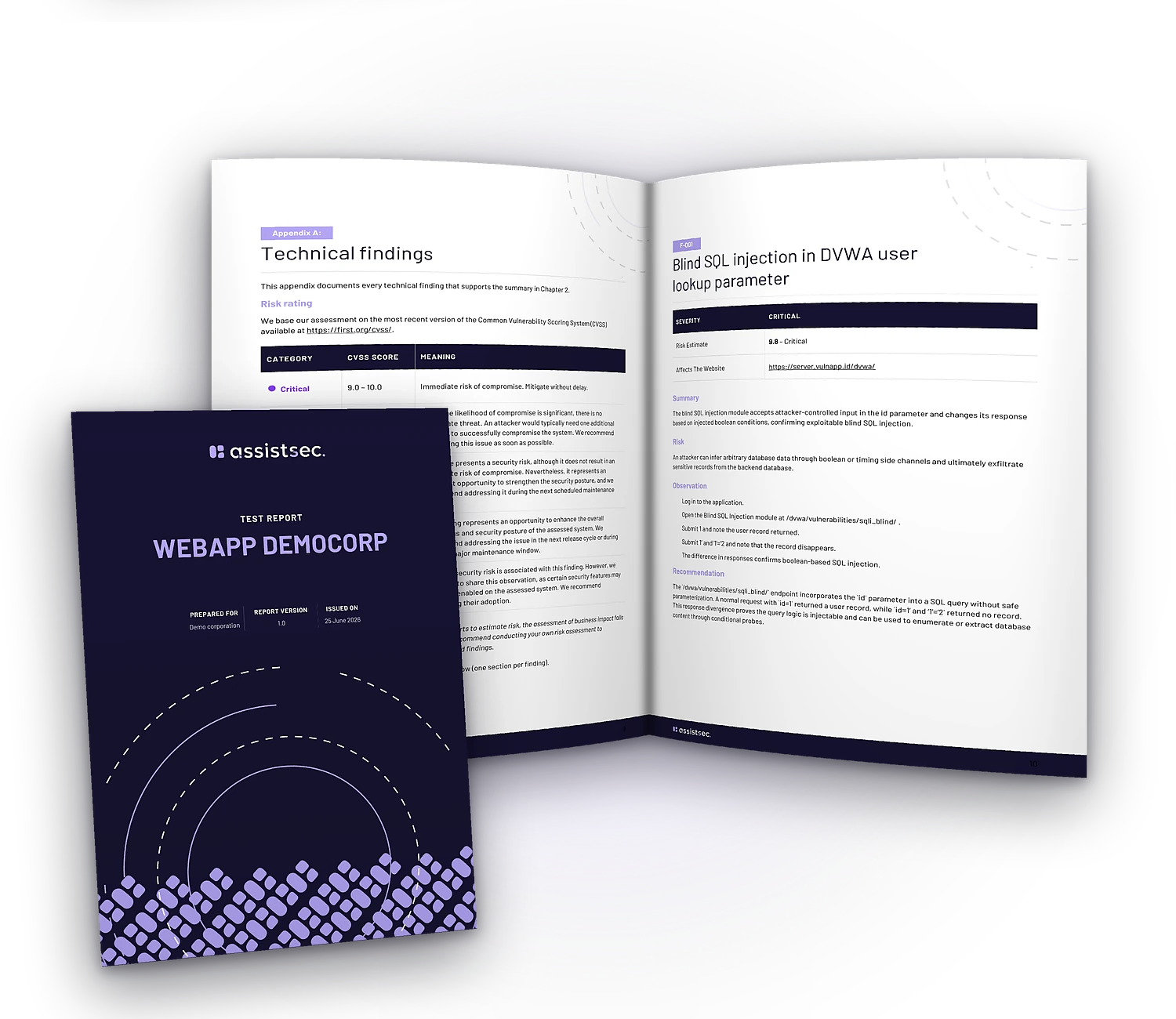
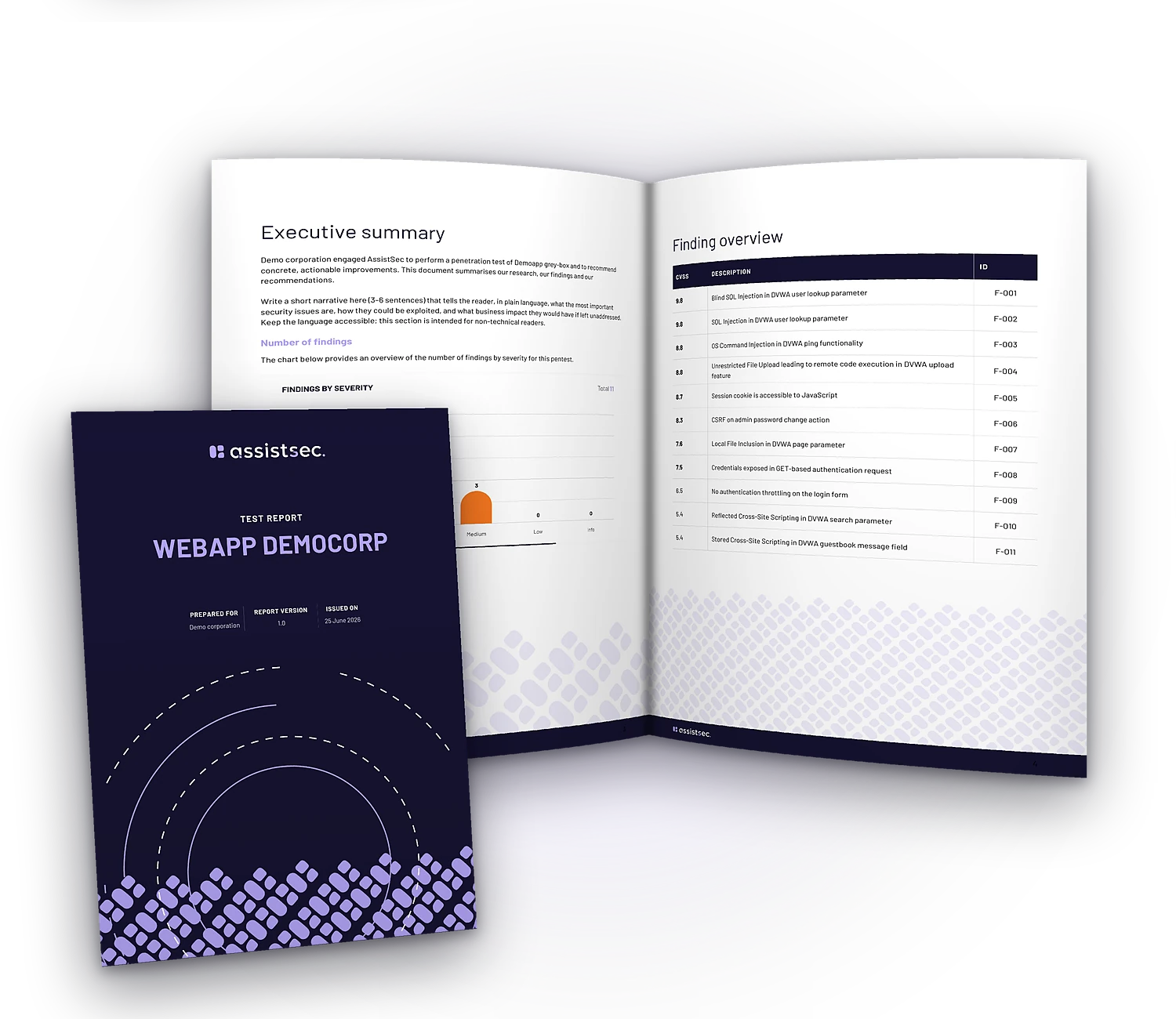
When the pentest is done, you receive a pentest report with every validated finding. Each vulnerability carries a CVSS score, so you see straight away where the biggest risks are. The report opens with a clear management summary, followed by in-depth technical detail and concrete recommendations to strengthen your environment right away. All results can also be viewed and followed up live in our ARGUS portal, including retests once a fix is in.
Report review
Once the report is delivered, we present all findings to the client. We tailor the presentation to the audience: a technical deep dive for IT or an accessible presentation for management. That way everyone involved understands the results and can take the right next steps.
Continuous pentesting or retests
AssistSec offers continuous pentesting as a monthly subscription. We scan the same scope for vulnerabilities on the first Monday of every month and show the results in our ARGUS platform. If you do not choose a monthly subscription, we retest all findings. You request a retest easily through our ARGUS platform.
What you get
Every test closes with a professional report that works for your developers and your board at the same time.
- Every finding with reproduction steps and evidence
- A risk analysis per finding, weighed against real business impact
- Concrete, prioritized recommendations your developers can act on
- An executive summary that explains the risk in a way anyone can understand
- Findings mapped to the relevant ISO 27001 controls through ARGUS
Why AssistSec for your web application pentest?
Comparing quotes? This is how a web application pentest by AssistSec compares with other pentest companies.
Certifications

No cure, no pay. We guarantee a validated finding, or you do not pay. This applies to every pentest we run, and you keep the full report either way.
Frequently asked questions
What is the difference between blackbox and greybox testing?
In a blackbox test we start with nothing more than a URL, exactly like an outside attacker. In a greybox test you give us accounts and, if you want, documentation, so we reach the deeper layers of the application within the same amount of time. Most organisations get more out of greybox.
How long does a pentest take?
That depends on the size of your application and the number of roles in it. We determine the effort during scoping and put it in writing before we start, so the scope and the price are agreed up front.
Can you test our production environment?
Yes, and we regularly do. We agree a test window in advance and treat destructive actions as out of scope unless you explicitly ask for them. If you would rather we work on an acceptance environment, that works too.
Do you help fix the findings as well?
You get concrete recommendations for every finding, and we are happy to walk your developers through them. Once a fix is live we retest it, so you know it holds.
Does a pentest help with ISO 27001 or NIS2?
A pentest gives you demonstrable evidence for a certification or audit track. Through ARGUS every finding is mapped to the relevant ISO 27001 controls, which makes reporting on your security posture considerably simpler.


Interested in a pentest?
Discover how AssistSec's AI agents give your organisation faster and more thorough insight into vulnerabilities.
Contact us