Network pentesting
With a network pentest from AssistSec we map the vulnerabilities and security risks inside your corporate network. We examine whether unauthorized users can gain access to the network, which systems and data they can reach, and what opportunities exist to move further within it. That gives you concrete insight into the security of your network environment, and tells you exactly which vulnerabilities need attention.
What is a network pentest
In an external and internal network pentest we test your defences from the outside as well as from the inside. First we examine your publicly reachable systems to find the weak spots attackers could exploit. Then we simulate a break-in into your internal network. We safely examine how far an attacker can get, which data they can reach and where your risks lie. That gives you a complete picture of all risks, and you know exactly where your security needs tightening.
Also see:ISO 27001 pentestNIS2 pentestDORA pentest
In the knowledge base:Unnecessary services on the internetInsecure transport and weak TLSOutdated components
How our agents reach your internal network
For the network pentest we link our VPN connection into your network. It sets up a secure connection to ARGUS over Tailscale and only opens the subnets in scope.
- Your networkVPN connection
- Tailscaleencrypted
- ARGUSAI agents
Network pentest with AI
The lead agent splits the network and the domain over twenty specialised agents, who work at the same time. What they find comes together in a graph of attack paths, with the shortest path to Domain Admins. A senior pentester validates every finding before you see it.
What we test
- 01
External network pentest
The outside view: everything your organisation exposes to the internet, examined the way an attacker without any access would. We map your internet-facing systems and probe them for the weak points that open a way in.
- 02
Internal network pentest
The inside view answers a different question: how far does someone get who is already on your network? That position is reached faster than you would think, through an infected laptop, a phishing mail or a cable in a meeting room. From there we work through the network the way a real intruder would, hunting for administrative rights on your systems.
- 03
Active Directory pentest
Active Directory is the key ring of your network: whoever controls the domain controls everything hanging off it. We examine your domain the way an attacker with one ordinary user account would, and follow every route that leads up towards Domain Administrator.
How a network pentest runs at AssistSec
Intake call
After your request via assistsec.ai, we contact you within 24 hours to schedule an intake call. In that call we discuss your specific question, if needed with one of our pentesters present, set the scope of the pentest and tell you more about how we work.
Drawing up a proposal
After the intake call we draw up a clear plan of approach for your organisation. It sets out exactly how we will run the pentest and what the planning looks like. You also see straight away how many days the test takes and what the total cost is, so you know exactly where you stand before anything starts.
Kick-off meeting
Once you approve the plan of approach, a kick-off meeting follows in which a senior pentester and the client meet. We go through the details of the pentest once more and record them in our intake form, with everything the test needs, such as accounts and URLs.
Execution with AI
Our autonomous agents work the network from both directions while our pentesters follow the paths that need human judgment: lateral movement, escalation through Active Directory and the route to your critical systems. Every finding is reproduced and rated by a senior pentester, so what reaches your report is real and nothing else.
Delivery of our findings
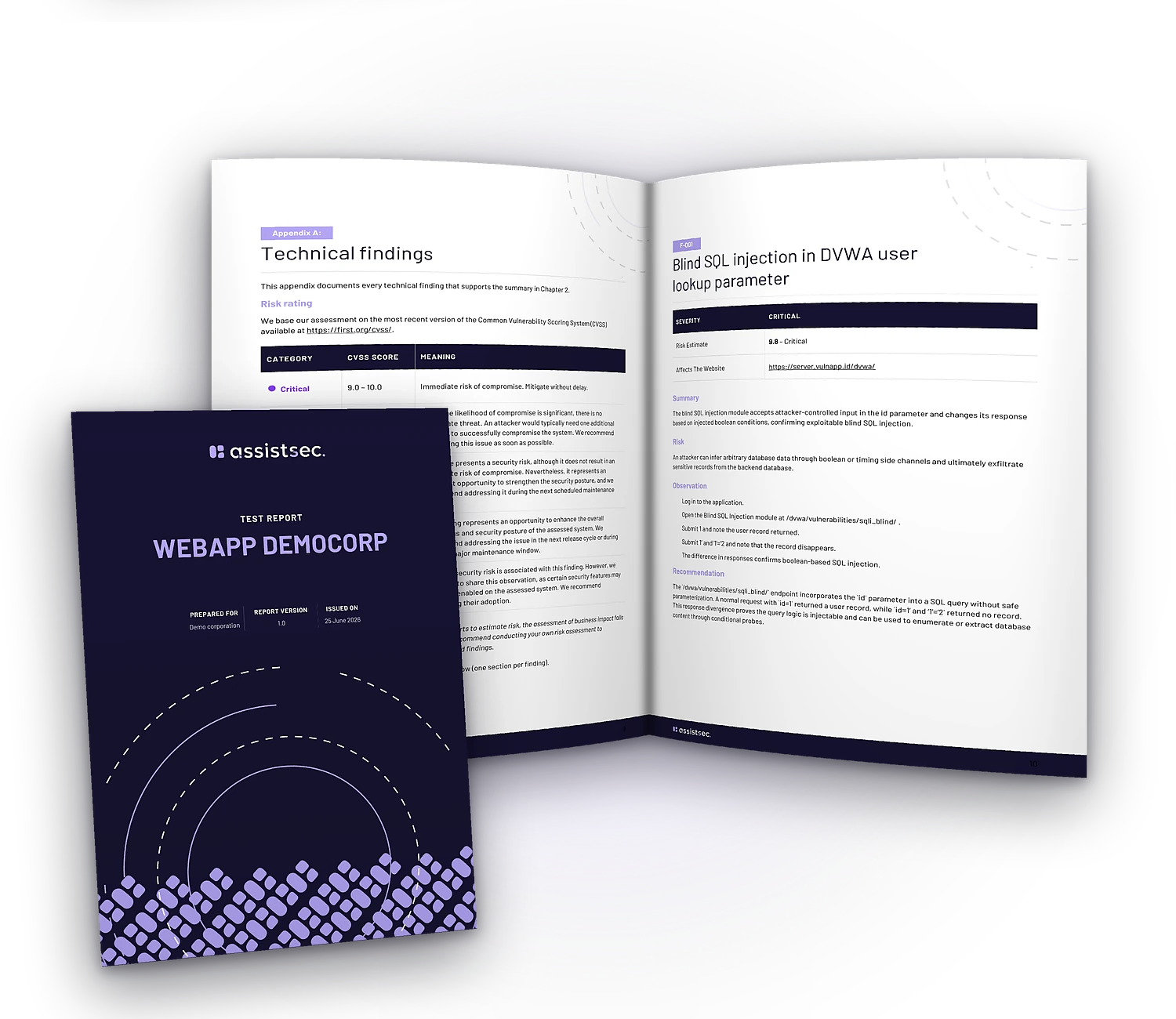
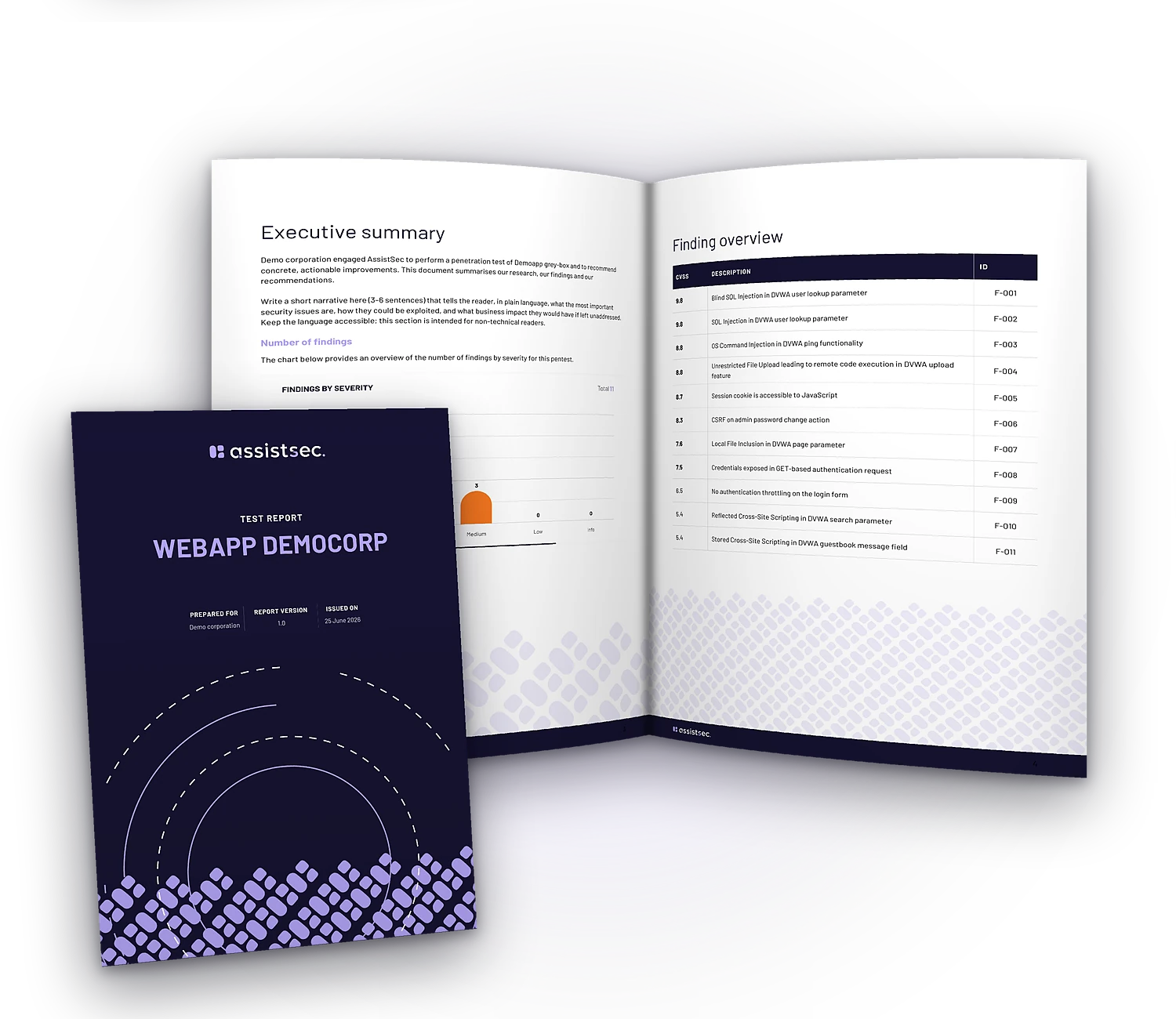
When the pentest is done, you receive a pentest report with every validated finding. Each vulnerability carries a CVSS score, so you see straight away where the biggest risks are. The report opens with a clear management summary, followed by in-depth technical detail and concrete recommendations to strengthen your environment right away. All results can also be viewed and followed up live in our ARGUS portal, including retests once a fix is in.
Report review
Once the report is delivered, we present all findings to the client. We tailor the presentation to the audience: a technical deep dive for IT or an accessible presentation for management. That way everyone involved understands the results and can take the right next steps.
Continuous pentesting or retests
AssistSec offers continuous pentesting as a monthly subscription. We scan the same scope for vulnerabilities on the first Monday of every month and show the results in our ARGUS platform. If you do not choose a monthly subscription, we retest all findings. You request a retest easily through our ARGUS platform.
What you get
Every finding is validated by a senior pentester and lands in your ARGUS portal the moment it is confirmed. AI helps us analyze the findings, connect the ones that form a path together and keep every recommendation concrete, so your team can start fixing while the test is still running.
- Every finding with the attack path, reproduction steps and evidence
- A risk analysis per finding, weighed against real business impact
- Concrete, prioritized recommendations your IT team can act on
- An executive summary that explains your exposure in plain terms
- Findings mapped to the relevant ISO 27001 controls through ARGUS
Why AssistSec for your network pentest?
Comparing quotes? This is how a network pentest by AssistSec compares with other pentest companies.
Certifications


No cure, no pay. We guarantee a validated finding, or you do not pay. This applies to every pentest we run, and you keep the full report either way.
Frequently asked questions
What is the difference between external and internal network testing?
An external test looks at what an attacker can reach from the internet: exposed services, remote access and the systems behind them. An internal test assumes the attacker is already inside, through a phishing mail, a compromised laptop or a malicious insider, and shows how far they could get from there. Together they give you the complete picture: how hard it is to get in, and what it costs you once someone does.
Is Active Directory part of the test?
Yes. Where a Windows domain is in scope, the internal phase includes it by default: permissions, Kerberos weaknesses, credential hygiene and the escalation paths that lead from a regular user account towards Domain Administrator. It is where attackers go first once inside, so a network test that skips it answers only half the question.
Will you always reach Domain Administrator?
No, and we do not promise to. If a path to Domain Administrator exists we are well placed to find it, but a test that ends without one is a good result, not a failed test: it means your defenses held against the routes we tried. Everything we find along the way is reported either way, because an attacker does not need full control to do real damage.
How do you test our internal network remotely?
We set up a Tailscale connection inside your network for that. You provide one small test system, physical or virtual, on which we install Tailscale; that system only makes an outbound, encrypted connection to us and becomes our workstation inside your network. No port has to be opened in your firewall and no inbound rules are needed. As soon as the test is finished we remove the connection and the access is gone.
Will the test disrupt our operations?
No. We agree a test window up front, avoid destructive actions unless you explicitly ask for them and coordinate with your IT team throughout the engagement. Denial-of-service testing is out of scope by default, and when something looks fragile we flag it instead of pushing it over.
What role do AI agents play in a network pentest?
Our autonomous agents give the engagement breadth: they enumerate the network, analyze findings for connections and keep working between the moments a human is looking. Our senior pentesters give it depth: they follow the escalation paths, validate every finding and decide what actually matters. AI assists our testers rather than replacing them, and nothing reaches your report without human validation.
Does a network pentest help with ISO 27001 or NIS2?
Yes. A network pentest is demonstrable evidence that you test your technical controls, which is exactly what ISO 27001 audits and NIS2-driven requirements ask for. Through ARGUS every finding is mapped to the relevant ISO 27001 controls, so the evidence is ready before the audit asks for it.


Interested in a pentest?
Discover how AssistSec's AI agents give your organisation faster and more thorough insight into vulnerabilities.
Contact us