NIS2 pentest
Since 15 August 2026 the Cyberbeveiligingswet has been in force, the Dutch implementation of the European NIS2 directive. Thousands of organisations now have to show that their security works, not merely that it exists. A pentest is the most direct proof there is. We test your applications, APIs and network, and you keep evidence with dates on it.
Request pentest- Cyberbeveiligingswet in force since 15 August 2026
- The duty of care asks for proof your security works
- Yearly testing is the norm, retest included
- Fixed price up front, no cure no pay
What is a NIS2 pentest
A NIS2 pentest is a penetration test carried out to meet the duty of care in the NIS2 directive and the Dutch Cyberbeveiligingswet. Ethical hackers attack your systems under controlled conditions and record what a real attacker could have done. The test itself is no different from any other pentest. The difference is what it serves, because NIS2 does not only ask for measures but for proof that those measures work.
What is NIS2
NIS2 is the European directive on network and information security, the successor of the first NIS directive from 2016. In the Netherlands it is implemented in the Cyberbeveiligingswet, which took effect on 15 August 2026. The law touches over eight thousand organisations in sectors such as energy, healthcare, transport, digital services and manufacturing, and through procurement requirements their suppliers as well.
If your organisation falls under it, three duties apply. You register with the supervisory authority, you file a first notification within 24 hours of a serious incident and you take appropriate measures to secure your systems. The board has to oversee this itself and can be held to account for it. That last duty is the duty of care, and that is where the pentest comes in.
Does NIS2 require a pentest
No. The word pentest appears neither in the directive nor in the law, and whoever claims NIS2 makes one mandatory is overselling. What the duty of care does ask for is appropriate measures and a policy to assess whether those measures work. So you do not only have to arrange your security, you have to be able to show it holds.
For that showing, a pentest is the most direct instrument there is. A controlled attack by ethical hackers proves whether your measures stop a real attacker, and it produces the dated evidence a supervisor or a large customer asks for. That is why a pentest is part of nearly every NIS2 plan, mandatory or not.
Which organisations fall under NIS2
The directive splits the sectors into two groups. Essential entities get the heaviest supervision, important entities a lighter regime with the same duty of care. The threshold is usually fifty employees or ten million euros in turnover, though the law designates some organisations regardless of size.
Essential entities
The sectors where an outage hits society directly.
- Energy
- Transport
- Banking and financial markets
- Healthcare
- Drinking water and waste water
- Digital infrastructure and ICT management
- Government
- Space
Important entities
The sectors where an outage hits the economy and supervision happens after the fact.
- Postal and courier services
- Waste management
- Chemicals
- Food
- Manufacturing
- Digital providers
- Research
If your sector is not listed, you are not done yet. Whoever supplies an organisation that falls under the law receives the requirements through the procurement contract. In practice that is how most smaller companies meet NIS2.
Which measures does Article 21 demand
The duty of care is not an open norm. Article 21 of the directive lists ten measures every organisation under NIS2 arranges at minimum. In plain words, these.
Risk analysis and security policy
Knowing what you protect, against whom and how.
Incident handling
Spotting an attack, handling it and learning from it.
Business continuity
Backups, recovery and keeping going when things break.
Supply chain security
Putting requirements on the suppliers you lean on.
Secure development and procurement
Building security into new systems, purchases and maintenance.
Assessing whether measures work
Written policy for testing your own security. This is where the pentest fits.
Cyber hygiene and training
Ground rules and training for everyone who works with the systems.
Cryptography
Encryption where the data calls for it.
Personnel security
Knowing who has access, from onboarding to departure.
Access control and MFA
Access by role, multi-factor authentication and secured communications.
A pentest directly serves at least four of these ten. It is the test of whether your measures work, it feeds your risk analysis, it probes what you built or bought, and the report is the evidence your supply chain can show its customers.
How a NIS2 pentest runs at AssistSec
Intake call
After your request via assistsec.ai, we contact you within 24 hours to schedule an intake call. In that call we discuss your specific question, if needed with one of our pentesters present, set the scope of the pentest and tell you more about how we work.
Test
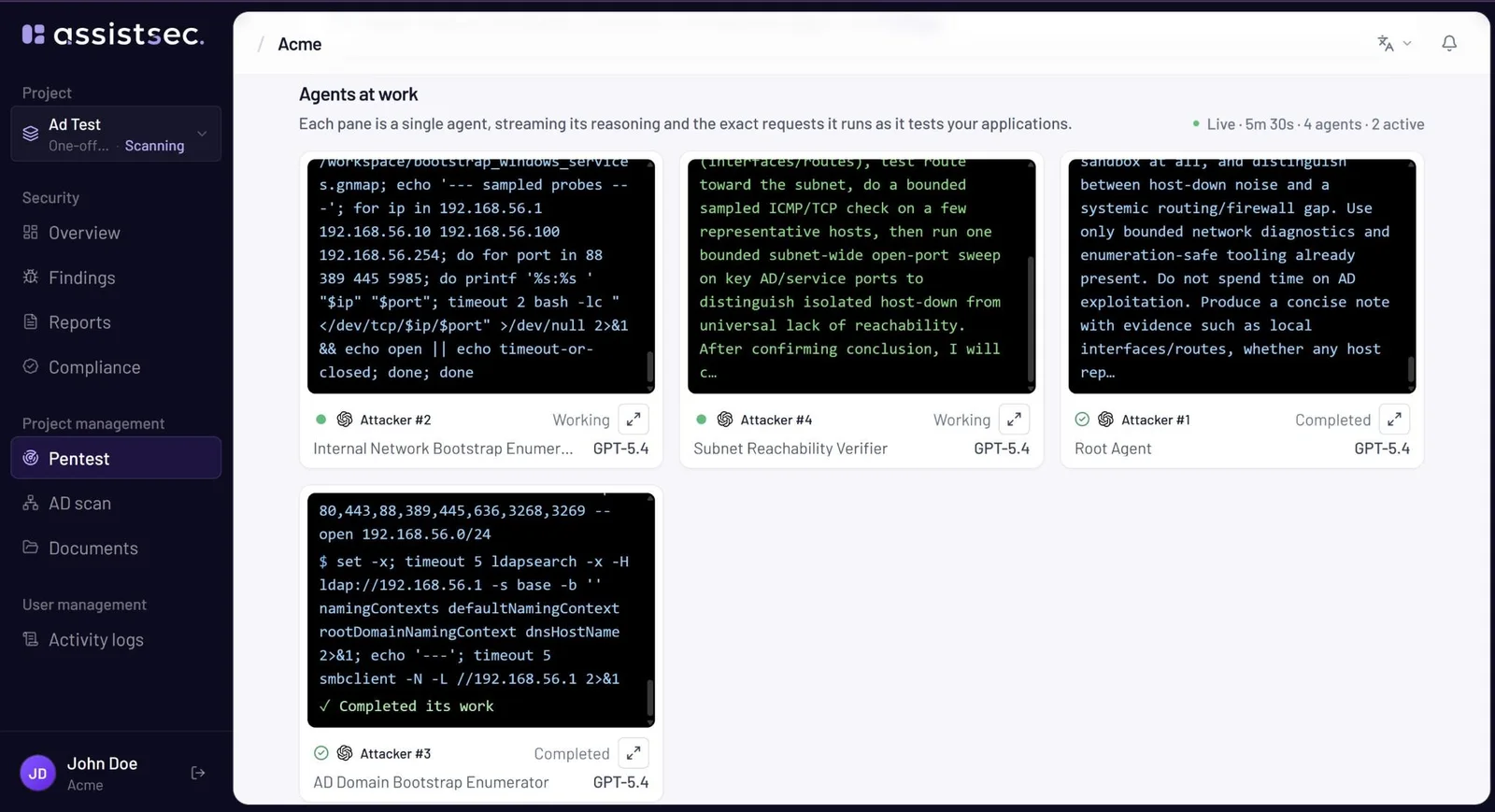
AI agents and senior pentesters attack the scope under controlled conditions. You watch live in our portal.
Report
Every finding validated by a person, with risk and concrete remediation advice, readable for board and engineers alike.
Retest
You fix, we verify. Every finding closes with a date on it, the way your duty of care asks.
Ongoing
Monthly scans keep the evidence current until the next pentest. The duty of care stays covered, all year.
Evidence that makes your duty of care demonstrable
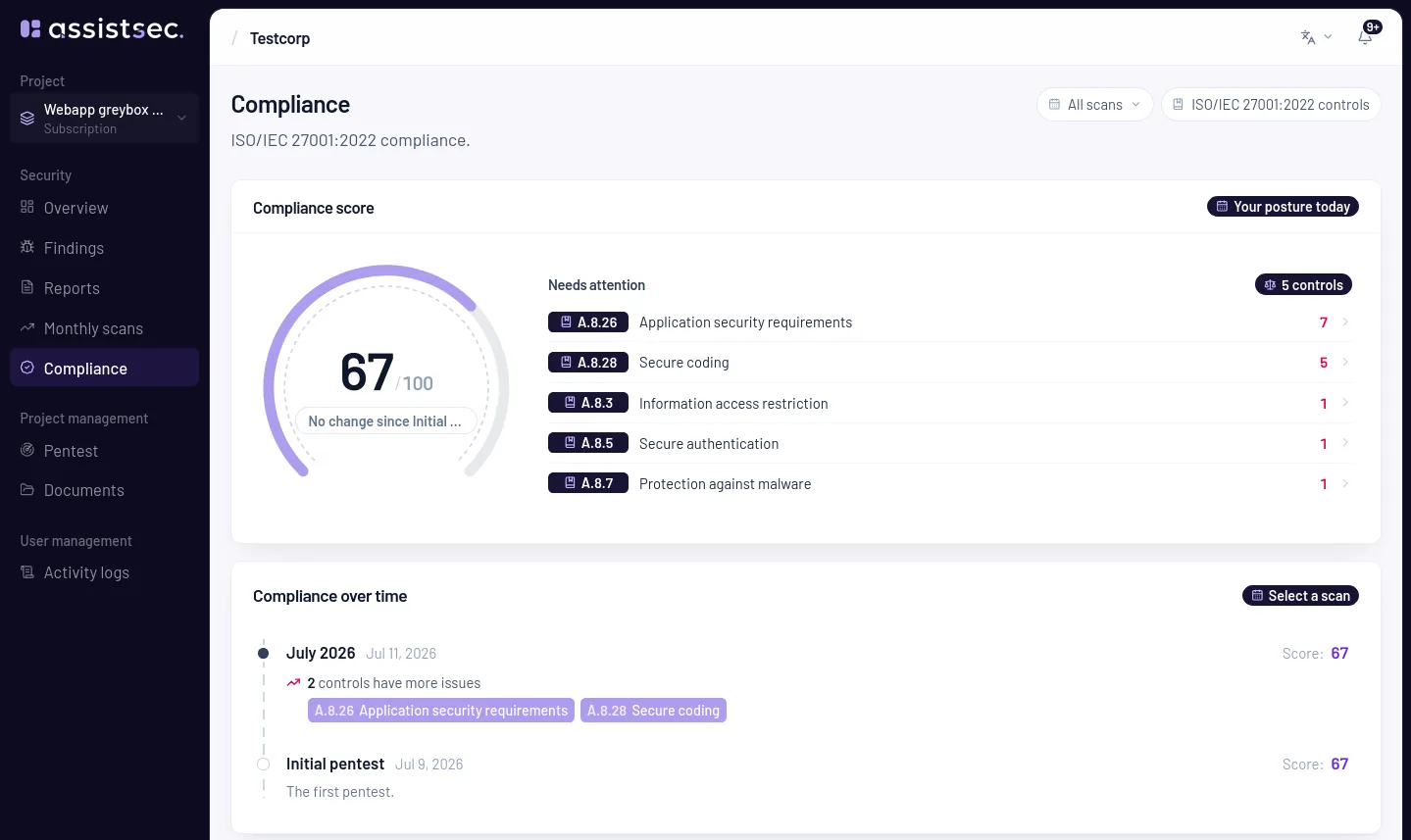
Our pentests run in our own portal. Every finding carries the date it was found, fixed and verified, and the retest is part of the engagement. When a supervisor or a customer asks how you assess your security, the answer is not a folder of old PDFs but an overview you open.
Tested continuously instead of once a year
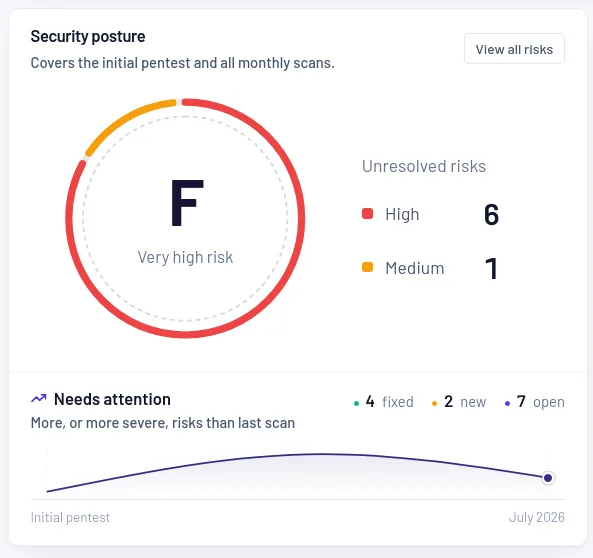
The duty of care does not pause after one test, and a report ten months old says little about today. That is why any pentest with us can carry on as monthly scans, with a fresh pass on the first Monday of every month. Your evidence never goes stale, and you are the first to see it when something new appears.
No cure, no pay. We guarantee a validated finding, or you do not pay. This applies to every pentest we run, and you keep the full report either way.
Frequently asked questions
Is a pentest mandatory under NIS2?
No, the law prescribes no method. The duty of care does demand that you take appropriate measures and assess whether they work. A pentest is the most direct evidence for that, and in practice the way organisations fill in that assessment. A scan alone shows that a tool ran, a pentest shows what an attacker could actually have done.
Does my organisation fall under NIS2?
The law applies to essential and important entities in sectors such as energy, healthcare, transport, water, digital infrastructure, government and manufacturing, usually from fifty employees or ten million euros in turnover. But organisations outside it feel it too, because customers who do fall under it must put requirements on their suppliers. If you are unsure, we look along at intake to see which systems it touches, and you hear it honestly if a pentest is not the right step yet.
Does NIS2 apply to small companies too?
Usually not directly. The law generally starts at fifty employees or ten million euros in turnover, with exceptions for registries and trust services among others. Indirectly it very much applies, because customers who fall under it must put security requirements on their suppliers. A pentest report of your own answers those questions in one go.
Which pentest do we need for NIS2?
The one that covers your most important systems. For most organisations those are the web applications customers sign in to, the APIs behind them and the network including Active Directory. We test all three, from outside and from inside, and help you choose the scope that fits your risks.
Which security measures does NIS2 require?
Article 21 names ten, from risk analysis and incident handling to access control with multi-factor authentication and supply chain security. One measure stands out for testing. You must have written policy for assessing whether your measures work, and a pentest is the most direct instrument for that.
How often should we test for NIS2?
The duty of care is continuous, so one test is a snapshot. Common practice is at least one pentest a year and a fresh test after major changes, such as a new application or a migration. Between pentests our monthly scans keep the evidence current, on the first Monday of every month.
What can we show a supervisor or a customer?
The full pentest report, plus the overview from our portal in which every finding carries the date it was found, fixed and verified. Together they show that your measures were tested and how the findings were handled, which is the assessment of effectiveness Article 21 asks for. It can be exported and read without a walkthrough from us.
What does NIS2 mean for our board?
The board has to approve the security measures itself and oversee their implementation, and can be held personally to account for it. An independent pentest gives the board exactly what it needs for that. An outside judgement on whether the measures work, with the findings and the follow-up in writing.
What are the fines under NIS2?
For essential entities fines can reach ten million euros or two percent of worldwide annual turnover, for important entities seven million euros or 1.4 percent. The supervisor can also issue binding instructions and, as a last resort, temporarily suspend executives. The fine is rarely the real risk though. The incident itself is.
What is the difference between NIS2 and the Cyberbeveiligingswet?
NIS2 is the European directive, the Cyberbeveiligingswet is the Dutch law that implements it. The directive itself puts no direct duties on companies, the law does. It has applied since 15 August 2026, so whoever starts now is running behind the law rather than ahead of it.
We are already ISO 27001 certified. Are we done for NIS2?
A long way, but not quite. The measures overlap heavily, so a working ISO 27001 management system covers most of the duty of care. NIS2 adds duties of its own, such as registering with the supervisor and the 24-hour notification duty. The same pentest produces evidence for both, and with us every finding is already mapped to ISO 27001.
What does a NIS2 pentest cost?
That depends on the scope. One application and the APIs behind it is a different engagement from several applications plus the network with Active Directory. We settle the scope in a short call and then give you a fixed price, so you know where you stand before anything starts. If we find nothing, you pay nothing.
Sources

Interested in a pentest?
Discover how AssistSec's AI agents give your organisation faster and more thorough insight into vulnerabilities.
Contact us