Continuous penetration testing explained
Your application passed a pentest. Since then, your development team has released new features, changed permissions and added another API integration. How much does that earlier result tell you about the application today?
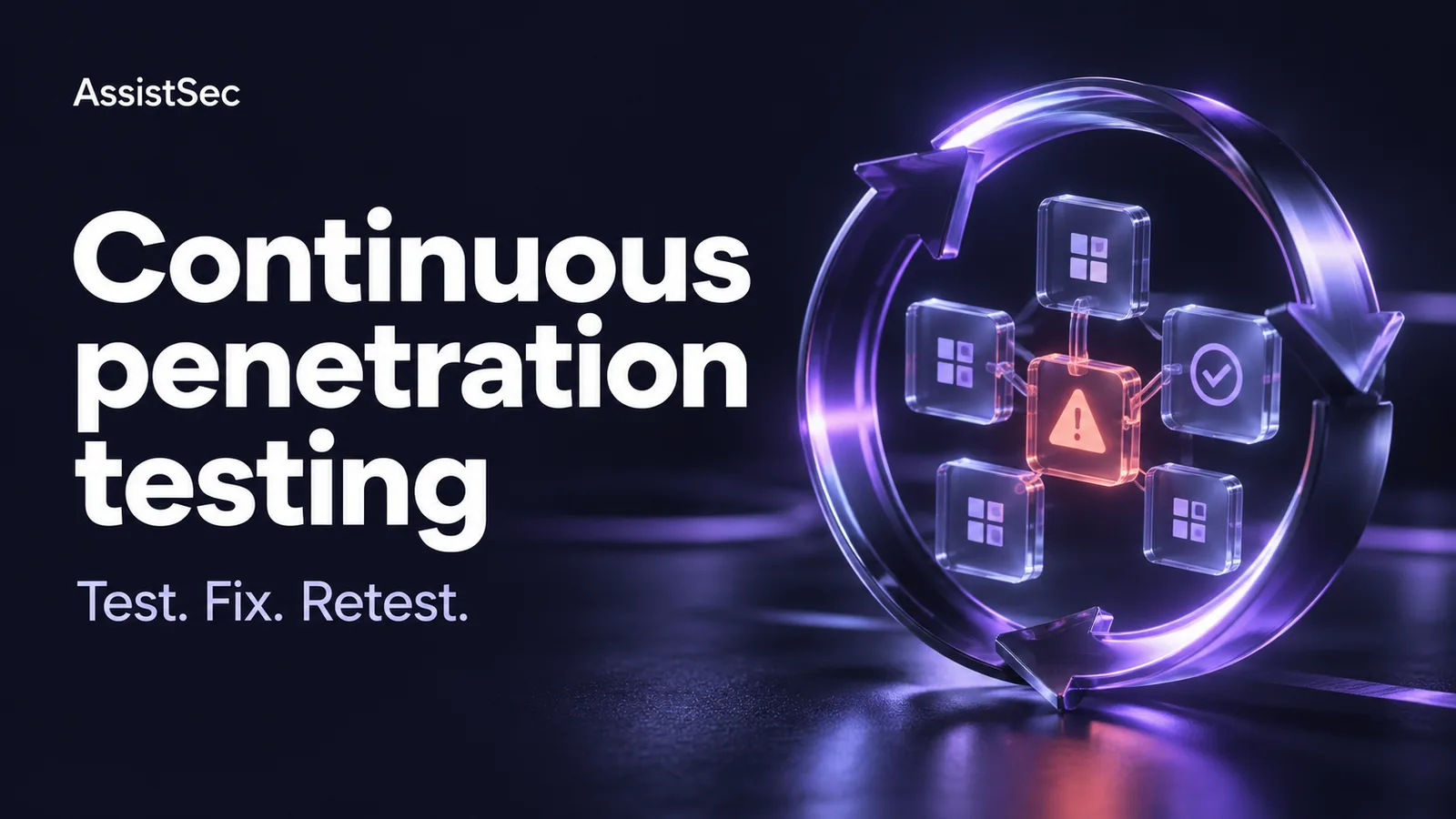
Continuous penetration testing makes security testing a recurring part of maintaining your application. It helps you check what has changed, investigate new weaknesses and verify whether previous fixes still work.
What is continuous penetration testing?
Continuous penetration testing is an ongoing programme of authorised security tests that examines whether weaknesses in an application or system can be exploited. Testing takes place at agreed intervals (this can be once a month or once a week), with findings followed through to remediation and retesting.
“Continuous” describes the ongoing process. It does not necessarily mean a pentester or automated tool is attacking every system around the clock. The frequency, scope and depth depend on the service you agree with your provider.
What happens between pentests matters
Consider a customer portal that introduces a new document-sharing feature.
The feature works as intended for ordinary users. However, an access-control mistake could allow someone to retrieve a document belonging to another account. The previous pentest cannot tell you whether that newly introduced functionality is secure, because that functionality was not available at the time of the previous pentest.
This is where recurring testing helps. It creates regular opportunities to examine changes and identify weaknesses within the agreed scope.
The same principle applies when you introduce user roles, change authentication or connect another service. Each change deserves consideration when deciding what to test next.
Continuous pentesting vs a one-off pentest
Both approaches have a useful role. The right choice depends on how your application changes and what assurance you need.
One-off pentest
A one-off pentest gives you a detailed assessment of an agreed scope at a particular time. It can help you prepare for a launch, review a major update or investigate a specific area of concern. The findings show what testers could identify in the version they assessed.
As your application changes, parts of that assessment become less representative of the current environment. New features, integrations and permissions can introduce weaknesses that were not present during the test.
Continuous pentesting
Continuous pentesting adds recurring assessments to that process. Your team gets regular opportunities to identify new issues, follow up on unresolved findings and check whether fixes have worked. Coverage still depends on the agreed scope, so changes to your application should be discussed with your provider.
More from the blog
View all blogs- News
AI Pentesting: Why organisations choose assistsec
Discover why more companies are choosing AI pentesting with AssistSec. We combine autonomous AI agents with the expertise of senior penetration testers to deliver comprehensive AI-powered penetration tests.
Nov 21, 2026 - Inside AssistSec
ISO 27001: what is it and what does it cost?
ISO 27001 is the standard for information security. Learn what it contains, how certification works, what it costs and how it relates to NIS2.
Nov 2, 2026 - Inside AssistSec
What is a pentest? Types, process and costs
A pentest is a controlled hacking attempt on your own systems. Learn which types exist, how it works, what it costs and what to look for.
Nov 2, 2026




Interested in a pentest?
Discover how AssistSec's AI agents give your organisation faster and more thorough insight into vulnerabilities.
Contact us